
Dermatology Department
Dermatology is an arm of medicine that handles the care of hair, nail and skin concerns. Some of the most common dermatologic concerns are acne, different forms of eczema, dandruff or alopecia (hair loss). Acne alone affects over 633 million people globally according Global Burden of Disease Study conducted in 2015.
Dermatologists work to resolve skin and hair related concerns in an effort to elevate patients’ physical and emotional wellbeing. They teach people about the steps they can take to maintain the health of their hair, nails and skins, such as routines to prevent outbreaks.
The department of Dermatology at Shalamar Hospital was set up in 1990 to treat the basic skin diseases and now it is one of the leading dermatology departments in the city. It has a rich history of scientific, educational and clinical advancements. The department is equipped with state of the art latest diagnostic and therapeutic facilities that includes skin biopsy, cryotherapy, cautery and advanced LASER machines. Our care is dedicated to not only the people of Lahore but our reputation draws patients both from the peripheries of Lahore and other cities as well. We are one of the largest clinical services at Shalamar Hospital with a great number of patients.
Our goal is to become a center of excellence in aesthetics and clinical dermatology offering comprehensive and advanced treatment facilities to our patients in an environment marked by compassion and care.
HAIR REDUCTION
LASERS AVIALABLE
- Nd YAG LASER (1064nm)
- DIODE LASER (800nm)
INDICATIONS
- Hirsutism (male pattern facial hair) in females
- Unwanted Facial hairs in men and women
- Unwanted body hairs in men and women
- Hairy congenital naevi
- Beckers nevus (pigmentary naevus with hair growth)
- Faun tail (hair growth at lower back)
- Hair bearing skin grafts
- Pseudofolliculitis (ingrown hairs)
- Folliculitis decalvans (severe recurrent infection of hairs causing scarring)
IDEAL PATIENT
- Lighter skin color
- Dark brown to black coarse hair
PROTOCOL
- Initial assessment is required before staring treatment that includes history examination and relevant investigations if required and written consent before the procedure is essential.
- Patient visits the clinic for every treatment session.
- There is no downtime
- Multiples sessions are required.
- Interval between sessions is 4 – 8 weeks.
- Patients should avoid hair plucking, waxing, threading and bleach prior and during the treatment.
EXPECTED RESULT
- 60 TO 80 % reduction in hairs after 6 to 8 sessions
SIDE EFFECTS / COMPLICATIONS
- No serious complications are reported
- Side effects are usually mild and resolve in few days
- Erythema
- Swelling
- Dyspigmentation
REMOVAL OF PIGMENTED LESIONS
LASERS AVIALABLE
- Q-SWITCHED LASER (532nm and 1064 nm)
INDICATIONS
- Tattoos
- Freckles
- Lentigines
- Congenital naevi (moles)
- Speckled naevus/ naevus spilus
- Seborrheic keratosis
- Café-au-lait macules
- Genital melanosis
- Nevus of Ota / Ito
- Mongolian blue spots
- Drug induced pigmentation
PROTOCOL
- Initial assessment is required before staring treatment that includes history examination
- Patient visits the clinic for every treatment session and written consent before the procedure is essential.
- Multiples sessions are required.
- Interval between sessions is 3-4 weeks
SIDE EFFECTS / COMPLICATIONS
- No serious complications are reported
- Side effects are usually mild and resolve in few days
- Whitening and subsequent Erythema
- Pinpoint bleeding
- Dyspigmentation
- Scarring
SKIN RESURFACING
LASERS AVIALABLE
- FRACTIONATED CO2 LASER (10,600nm)
INDICATIONS
- Acne Scars
- Open Pores
- Facial Rejuvenation
- Fine Lines and wrinkles
IDEAL PATIENT
- Lighter skin color
- Patients with steroid induced skin atrophy should be avoided
PROTOCOL
- Initial assessment is required before staring treatment that includes history examination and written consent before the procedure is essential.
- Patient visits the clinic for every treatment session.
- There is downtime of 4-5 days.
- Multiples sessions are required.
- Interval between sessions is 4-6 weeks
EXPECTED RESULT
- Typically a 60- 80% improvement is expected in patients after 8-10 sessions
SIDE EFFECTS / COMPLICATIONS
- No serious complications are reported
- Side effects are usually mild and resolve in few days
- Post op tenderness
- Erythema and swelling
- Scarring
- Extreme caution is needed when treating darker skinned individuals as permanent loss or variable pigmentation may occur
HIFU (HIGH INTENSITY FOCUSSED ULTRASOUND)
INDICATIONS:
HIFU has many aesthetic benefits, including:
- Wrinkle reduction
- Tightening of sagging skin
- Lifting the cheeks, eyebrows, and eyelids
- Defines the jawline
- Tightening of the décolletage
- Smoothing the skin
REMOVAL OF BENIGN LESIONS
LASERS AVIALABLE
- Ablative CO2 LASER (10,600nm)
INDICATIONS
- Skin tags
- Milia
- Xanthelasma
- Compound naevi
- Viral Warts
- Seborheic keratosis
- Molluscum contagiosum
PROTOCOL
- Initial assessment is required before staring treatment that includes history examination and written consent before the procedure is essential.
- Patient visits the clinic for every treatment session.
- 1-3 sessions are required.
- Interval between sessions is 3-4 weeks
SIDE EFFECTS / COMPLICATIONS
- No serious complications are reported
- Side effects are usually mild and resolve in few days
- Crusting
- Bleeding
- Dyspigmentation
- Scarring if larger lesion
Skin diseases have been treated with lasers worldwide since early 1960s.
The light emitted from a laser is
- Monochromatic
- Directional
- Coherent
Principal targets of laser in skin are
- Melanin
- Hemoglobin
- Water
All have different absorption spectra that selectively absorbs certain wavelengths hence different lasers have different purpose. The aim is to destroy target cells and not to harm the surrounding tissue.
Platelet-rich plasma (PRP) is an increased concentration of autologous platelets suspended in a small amount of plasma after centrifugation and used for injection into a wound or a particular skin condition.
Platelet-rich plasma is also called autologous platelet gel, plasma rich in growth factors (PRGF), and platelet concentrate (PC).
INDICATIONS
- Hair loss – PRP has been shown to reinvigorate dormant hair follicles and stimulate new hair growth in alopecia
- Androgenic alopecia
- Female pattern baldness
- Telogen effluvium
- Hair thinning
- Facial rejuvenation/ Scarring (combined with microneedling with DERMAPEN)
- Acne scars
- Pigmentation and melasma
- Skin tightening
- Fine lines
- Dark circles
- Wound healing
- Post-traumatic scars – PRP combined with centrifuged fat tissue and fractional laser resurfacing improve the cosmetic appearance of scars
- Venous and arterial leg ulcers
- Diabetic foot ulcers
- Pressure ulcers (bedsores)
- Skin graft donor sites
- First and second-degree thermal burns
CONTRAINDICATIONS
- Critical thrombocytopenia (low platelet count)
- Haemodynamic instability (collapse)
- Sepsis (infection)
- Acute and chronic infections
- Anti-coagulation therapy (warfarin, heparin)
- CRYOTHERAPY:
Cryotherapy is a minimally invasive procedure that uses an extremely cold liquid or instrument to freeze and destroy abnormal tissue that requires elimination. It is also referred to as cryosurgery or cryoablation. It is a simple, cost-effective, efficacious and aesthetically acceptable modality for the treatment of various dermatoses.
CRYOGEN
Liquid nitrogen (most commonly used) -196°C
INDICATIONS
- Skin tags
- Milia
- Seborrhoeic keratoses
- Actinic/solar keratoses
- Viral Warts
- Molluscum contagiosum
CONTRAINDICATIONS
- Raynauds disease/ cold intolerance
- Vasculitis / vasculopathy
- Cryoglobulinemia
- Lesions over the nasolabial folds, eyelid margins, ala-nasii, hair bearing sites
- Immunosuppression
- Previous sensitivity or adverse reaction to cryotherapy
SIDE EFFECTS
- Local pain and swelling
- Dyspigmentation
- Blister formation
- Bleeding or ulceration
- Scarring
- ELECTROCAUTERY:
It is the application of heat to the living tissue with the help of a metal element or burner which is heated by the passage of electricity, and the hot element is applied to the skin or lesion to be treated. Heat causes tissue coagulation and varying degrees of tissue destruction.
INDICATIONS:
- Viral Warts
- Molluscum contagiousum
- Xanthalesma
- Syringomas
- Pyogenic granuloma
- Freckles and lentigines
- Skin tags
- Seborrheic keratosis
- Milia
CONTRAINDICATIONS:
- Patients with implanted cardiac defibrillator should be referred to plastic surgery
- Infected wounds
- Keloid/ hypertrophic scars
SIDE AFFECTS:
- Pain and swelling
- Infection
- Dyspigmentation
- Scarring
- PHOTOTHERAPY (NARROW BAND UVB)
Phototherapy or light therapy is a form of treatment of skin conditions involving the administration of non ionizing radiations in controlled manner to the skin, most commonly in the ultraviolet part of the electromagnetic spectrum.
The UVB part of the spectrum is defined as the wavelength between 280-320 nm. The narrow band UVB is between 311-313 nm.
UVB phototherapy has anti inflammatory, immunosuppressive and cytotoxic properties.
INDICATIONS:
- Vitiligo
- Psoriasis
- Atopic eczema/ eczema
- Polymorphic light eruption
CONTRAINDICATIONS:
- Patients unwilling or unable to comply to safety procedures
- Patient who are medically unfit and unable to stand
- Dysplastic nevus syndrome
- Systemic Lupus Erythematosus
- Dermatomyositis
- Genetic skin cancer syndrome
- Any pre-malignant skin lesion
- Photo induced epilepsy
- Bullous pemphigoid/ pemphigus
SIDE AFFECTS:
- Erythema
- Pruritus
- Reactivation of herpes simplex virus
- Blistering
- Photoageing
- INTRALESIONAL INJECTION:
BRIEF INTRODUCTION:
An intralesional injection is the direct injection of a therapeutic substance into a lesion or into the skin. The aim of an intralesional injection is to deliver a high concentration of medicine into the site of the pathology to maximize efficacy while minimizing systemic adverse effects of the drug.
DRUGS USED FOR INTRALESIONAL INJECTION:
- Tiamcinolone acetonide
- Vitamin D
- Transamine(Intralesional/micro needling)
- 5-FU
- Bleomycin
- Methotrexate
INDICATIONS
- Keloids/ hypertrophic scars
- Alopecia arteata
- Hypertrophic lichen planus
- Viral warts
- Melasma
- Cutaneous leishmaniasis
- Nail psoriasis
CONTRAINDICATIONS:
- Local skin infections
- Allergy to intralesional drug
- Widespread/extensive diseases
- MINOR SURGICAL PROCEDURES:
INDICATIONS:
DIAGNOSTIC
- All suspected neoplastic lesions
- All bullous disorders
- Atypical moles or pigmented lesions
- To rule out the cause of scarring alopecia
- To clarify a diagnosis when a limited number of entities are under consideration
THERAPEUTIC
- Superficial solitary SCC
- BCC
- Lentigo maligna
- Malignant meloma
- Benign soft tissue tumors
- Tumors of skin appendages
CONTRAINDICATION
- Active infection at the biopsy site
- Any bleeding disorder
- Taking any anticoagulant medication
- Known allergy to local anesthetic
SIDE EFFECTS
- Bleeding
- Pain
- Infection
- Hematoma
- Allergic reaction
- Scar formation
- Sepsis
- SCRAPPING FOR FUNGUS:
INTRODUCTION:
Skin, hair and nail tissue are collected for microscopy and culture (mycology) to establish or confirm the diagnosis of a FUNGAL INFECTION.
Specimens for fungal microscopy and culture are transported to the laboratory in a sterile container or a black paper envelope and then examined under light microscope.
REAGENTS:
10% Potassium hydroxide (KOH)
CLINICAL SIGNIFICANCE:
Dermatophytosis is a clinical condition caused by fungal infection of the skin, hair and nails. The fungi that cause parasitic infections feed on keratin, the material found in the outer layer of skin, hair and nails. These fungi thrive on skin that is warm and moist, but may also survive directly on the outsides of hair shafts or in their interiors.
Year
| Date of activity | Activity type | Activity title |
2025 | 24th April,2025 | Scientific Session | The Challenge Of Resistant Dermatophytosis |
15th April,2025 | Workshop | Master Class On Facial Fillers | |
2024 | 24th April,2024 | Scientific Session | Exosomes-An Emerging Trend In Treatment Of Androgenetic Alopecia |
22nd April,2024
| Workshop | Leprosy Workshop | |
23rd February,2024
| Workshop | SPSS Workshop | |
2023
| 2nd Feb,2023 | Scientific Session | Conventional And Innovative Treatment Of Vitiligo
|
1st Feb,2023 | Workshop | Dermatoscopy Workshop | |
18th Sep, 2023
| Workshop | Aesthetic Master Class Basic Botox & Fillers
| |
2022 | 3rd Feb,2022 | Scientific Session | Exploring New Horizons In Hirsutism |
2020 | 2nd Feb,2020
| Scientific Session | Leprosy |
1st Feb,2020
| Workshop | Dermatopathology |
In addition, to strengthen patient care and expand the scope of dermatology services, the following machines and technologies have been added in the Dermatology Department:
Year
| Date of services added | Name of machine |
2019 | 19th Dec,2019 | Nd-Yag laser machine |
10-12-2019 | Cooling Machine | |
2020 | 15th May,2020 | Co2 Laser Machine |
2021 | 19th May,2021 | Q-switch Laser Machine |
26th Sept,2021 | Diode Laser Machine | |
2022 | 16th June,2022 | HIFU |
2024 | 20th Jan,2024 | Cryogun |
4th June,2024 | New Electrocautery machine | |
25th June,2024 | Derma pen | |
2025 | 16th June,2025 | New Nd-Yag Laser Machine |
Cardiologists
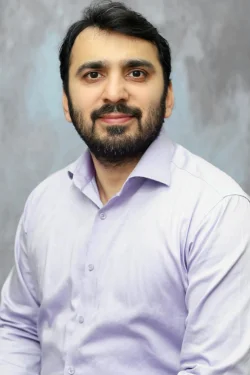
Dr. Fraz Ahmad
MBBS, FCPS (Cardiology), CCK(USA) ,FACC(USA) Cath Lab Director Interventional Cardiologist & HOD
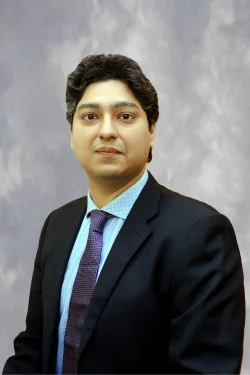
Dr. Muhammad Daniyal
MBBS, FCPS, MRCP(Medicine), CCK (USA) Assistant Professor-Cardiology
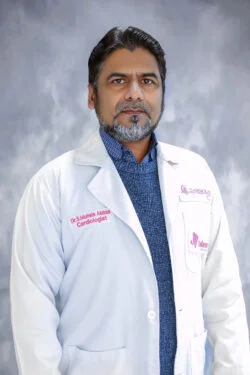
Dr. Syed Mohsin Abbas
Consultant Cardiologist
Please call +92-42-111-205-205 Ext 543 for any further queries